You Don’t Need “Big T” Trauma to Have Trauma Responses
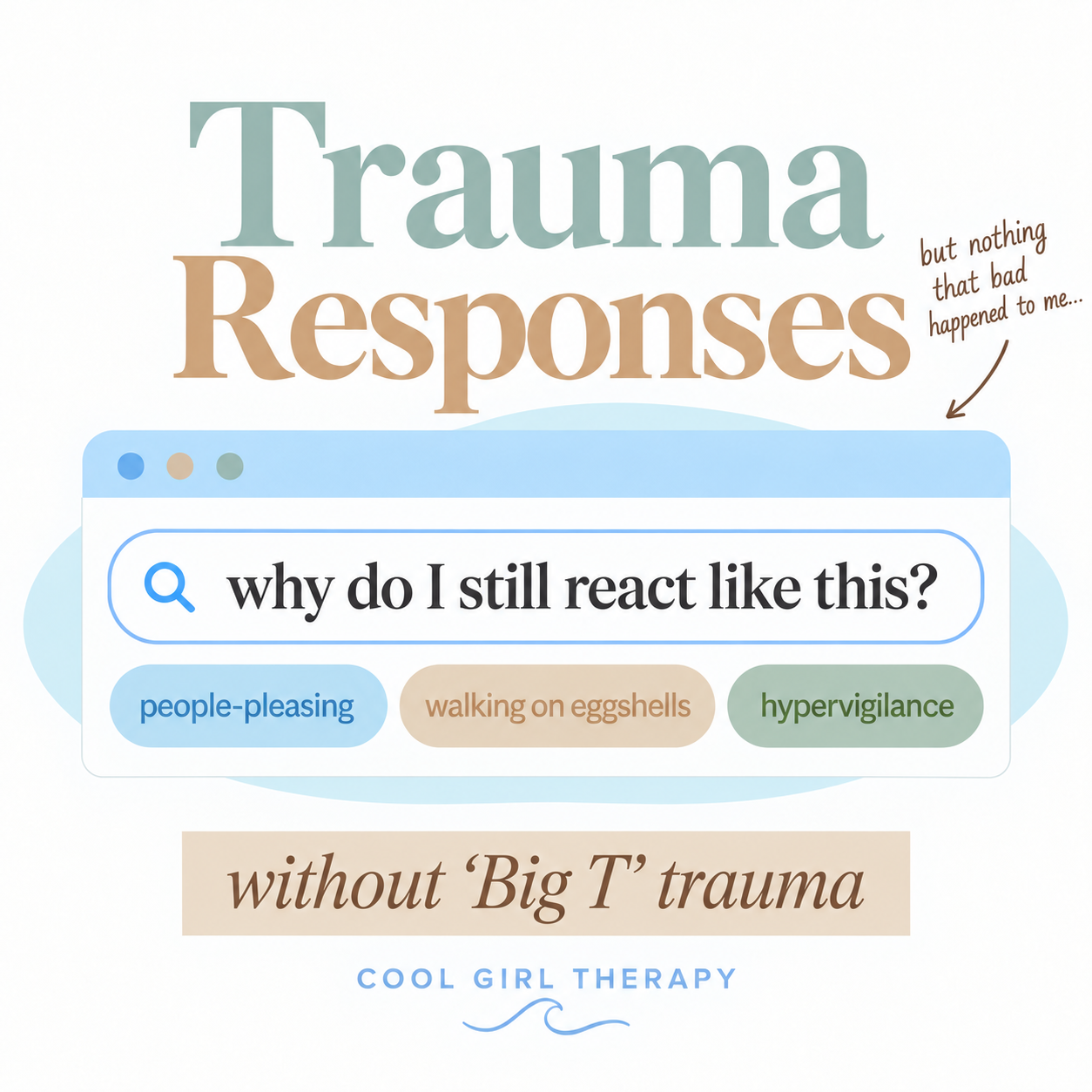
“But nothing that bad happened to me.”
I hear some version of this all the time.
Usually from someone who is functioning pretty well on paper.
They work. They have friends. They pay their bills. They may even be the person everyone else calls when something goes wrong.
And then they tell me they can’t relax when someone is upset with them.
They rehearse conversations before having them.
They feel guilty saying no.
They can tell something is wrong from one change in someone’s tone.
They’ve spent their whole life being “the easy one.”
And somewhere in the middle of telling me all of this, they say:
But I didn’t have a traumatic childhood.
Maybe not in the way you’ve always imagined trauma.
That doesn’t mean your nervous system didn’t learn anything from it.
Can you have trauma responses without abuse?
Yes, you can have stress and trauma-like responses without having a history of physical or sexual abuse.
That doesn’t automatically mean you have PTSD, and not every difficult childhood experience is a clinical trauma.
But repeated emotional experiences can still shape how your nervous system responds to relationships, conflict, uncertainty, and stress.
Maybe nobody hit you.
Maybe your parents stayed together.
Maybe you had birthdays, vacations, and everything you needed materially.
And maybe you also learned that someone else’s mood determined whether the house felt safe.
Maybe your feelings were called dramatic.
Maybe conflict meant silence for three days.
Maybe you were expected to be mature, reasonable, helpful, and low-maintenance long before you were actually old enough to handle that role.
Those things can leave a mark too.
What do “Big T” and “little t” trauma actually mean?
You may have heard people talk about “Big T” and “little t” trauma.
They’re informal terms, not official diagnoses.
“Big T” is usually used to describe the experiences most people immediately recognize as traumatic: assault, serious accidents, combat, severe abuse, disasters, or other situations involving significant danger.
“Little t” is often used for experiences that may be less dramatic from the outside but happen repeatedly or leave you feeling chronically unsafe, unsupported, or emotionally alone.
That can include childhood emotional neglect, bullying, unpredictable parenting, constant criticism, growing up around conflict, or never knowing which version of a parent you were going to get.
The point isn’t to decide which category you earned.
The more useful question is:
What did your system learn from what happened?
Why am I always walking on eggshells?
If you grew up around unpredictable moods, criticism, tension, or emotional shutdown, you may have gotten very good at reading a room.
As a kid, that skill may have helped you.
You knew when not to ask.
When to stay quiet.
When to make a joke.
When to agree.
When to disappear into your room.
The problem is that your nervous system doesn’t automatically retire that strategy when you turn 30.
So now you may notice yourself scanning your partner’s face.
Reading into a coworker’s email.
Assuming “we need to talk” means something terrible is coming.
Feeling a wave of anxiety when someone’s tone changes.
That’s sometimes called hypervigilance: being highly alert to possible signs that something is wrong.
You may know logically that you’re safe.
Your body may still be waiting for the other shoe to drop.
Is people-pleasing a trauma response?
Sometimes.
People-pleasing can come from a lot of places, but for some people it started as an adaptation.
If keeping other people happy made life more predictable, you learned to do that.
If disagreement led to withdrawal, anger, guilt, or rejection, you learned to avoid disagreement.
If being easy got you closeness, you got very good at being easy.
So now you might:
say yes and resent it later.
overexplain simple boundaries.
feel responsible for everyone’s comfort.
panic when someone is disappointed in you.
apologize even when you didn’t do anything wrong.
call yourself “low-maintenance” while quietly feeling exhausted.
It can look like a personality trait.
Sometimes it started as a relationship strategy.
What does childhood emotional neglect look like in adults?
Emotional neglect can be especially confusing because it’s about what didn’t happen.
You may not have obvious memories of abuse.
Instead, there may have been a lack of curiosity about your inner world.
Nobody really asked what you felt.
Big emotions were inconvenient.
You got practical support, but not much emotional support.
You learned to handle things yourself.
As an adult, that can look like being very independent while having a hard time asking for help.
It can look like knowing exactly what everyone else needs and having no idea what you need.
It can look like craving closeness and then feeling uncomfortable when someone gets too close.
It can look like saying, “I’m fine,” automatically.
Maybe the problem isn’t that you’re “too sensitive”
A lot of people come to therapy assuming the goal is to become less affected by things.
Less anxious.
Less reactive.
Less emotional.
Sometimes the more useful question is:
Why does this particular thing hit so hard?
Why does someone being disappointed in you feel unbearable?
Why does setting a boundary make you feel guilty for hours?
Why does conflict make your body feel like something terrible is happening?
Why do you immediately start figuring out how to fix someone else’s mood?
Those reactions usually make more sense when you stop treating them like random flaws and start looking at what they were built around.
Therapy doesn’t have to be about proving your childhood was bad
This is especially important if you’re someone who is doing pretty well day to day.
You don’t need to come into therapy with a dramatic story.
You don’t need to know whether the word “trauma” fits.
You don’t need to decide your parents were terrible people.
We can start with what’s happening now.
Maybe you want to stop overthinking every interaction.
Maybe you want to set a boundary without feeling sick afterward.
Maybe you want to know what you feel before immediately worrying about what someone else feels.
Maybe you want relationships that don’t require you to earn closeness by being useful, agreeable, or easy.
That’s enough to work with.
Online therapy for people who look fine on the outside
A lot of the people I work with are functioning.
They have careers, relationships, responsibilities, and lives that look pretty normal from the outside.
They’re not looking for crisis treatment.
They’re looking for a weekly space to understand the patterns that keep showing up underneath everything else.
In online trauma therapy in California, we can work on people-pleasing, relationship anxiety, boundaries, childhood emotional neglect, emotionally immature family dynamics, and the stress responses that keep following you into adulthood.
The point isn’t to turn your past into a bigger story.
It’s to help the present feel less controlled by it.
If you keep saying “but it wasn’t that bad…”
You may not need to answer that question before getting support.
Something can have been subtle and still have shaped you.
Your parents can have loved you and still not have known how to meet you emotionally.
You can have had a “good childhood” and still carry patterns you don’t want anymore.
You can be doing well and still want things to feel easier.
That counts.
If this connects with what you’ve been noticing, you might also want to read about emotionally immature parents, people-pleasing and the “Cool Girl” pattern, or online trauma therapy in California.
If you’re functioning day to day but tired of overthinking, people-pleasing, or feeling responsible for everyone else’s emotions, schedule a free 15-minute consultation. You don’t need to know exactly what to call it before we talk.