Why a Therapist Might Refer You Out After a Consultation (And Why That’s a Good Sign)
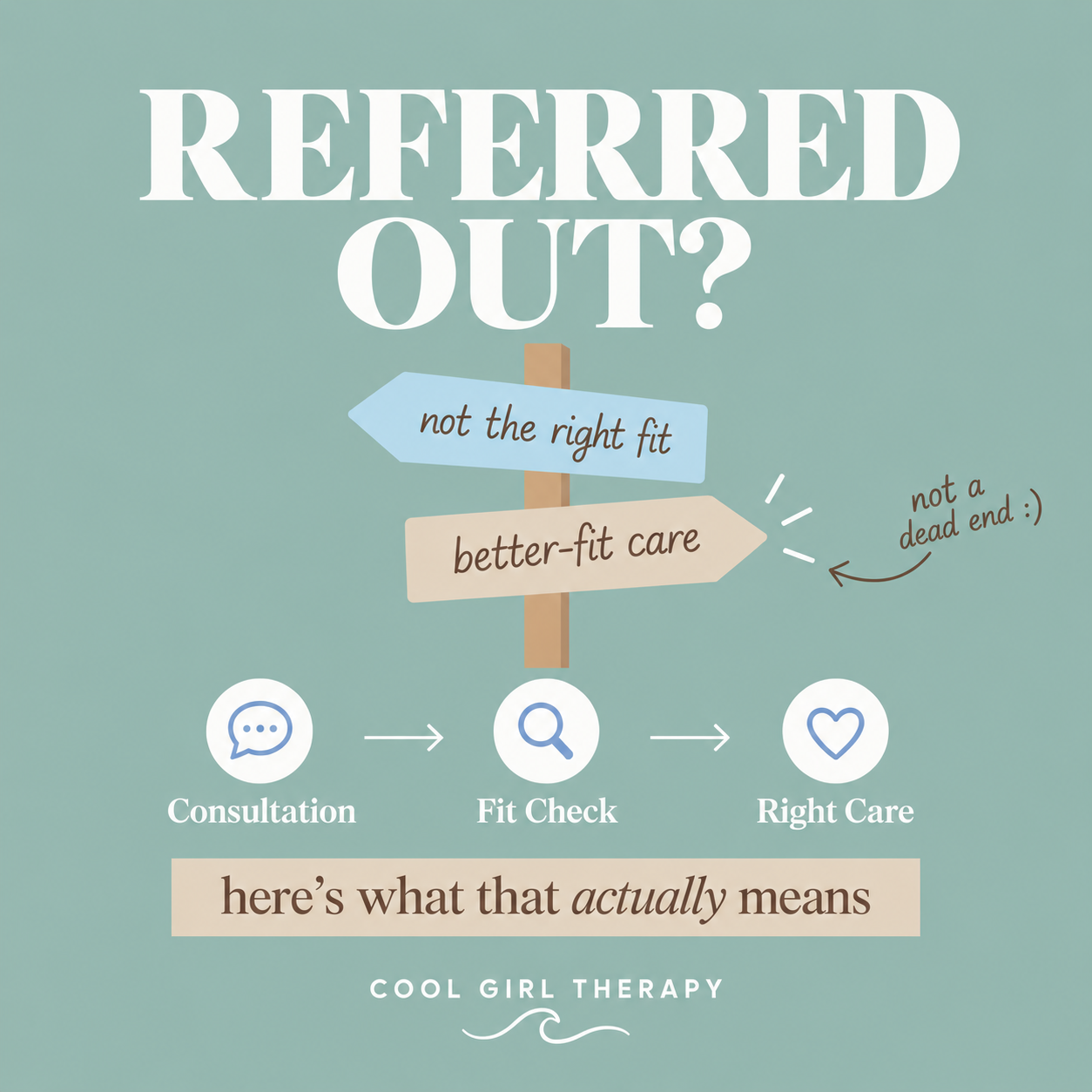
You book a free consultation. You explain what’s been going on.
And instead of scheduling your first session, the therapist says something like:
I don’t think I’m the best person for this, but I think you’d be better served by someone with more specific experience.
Even when it’s said kindly, that can sting.
You might leave wondering:
Was I too much?
Is my situation worse than I thought?
Did they just not want to work with me?
Usually, that isn’t what’s happening.
Sometimes referring you to someone else is one of the clearest signs that a therapist is taking your care seriously.
Therapists aren’t trained to treat everything
Therapy isn’t one universal skill that works the same way for every mental health concern.
Different therapists build different areas of training, experience, and clinical depth. Someone can be an excellent therapist and still not be the right therapist for every person who contacts them.
My practice focuses on concerns like anxiety, people-pleasing, intergenerational trauma, emotional neglect, difficult family dynamics, boundaries, identity, and relationship patterns, including experiences that can come up in multicultural and second-generation families.
That’s the kind of weekly outpatient therapy my practice is designed around.
Other concerns may call for more specialized training, a particular treatment approach, a coordinated treatment team, or more support than once-a-week telehealth can provide.
There’s a clinical phrase for this: scope of competence.
In normal-person language, it means therapists should know what they’re equipped to treat—and know when someone else may be better qualified.
Being licensed doesn’t make a therapist an expert in every diagnosis, therapy modality, or level of mental health care. Sometimes the responsible answer is simply:
This deserves someone who works with this all the time.
When I might recommend more specialized care
There are some concerns I intentionally refer to clinicians with more specialized training when they are the primary reason someone is seeking therapy.
That might include OCD that would benefit from specialized treatment, eating disorders that require coordinated medical and nutritional care, substance use concerns that need dedicated addiction treatment, compulsive sexual behavior, severe or complex trauma presentations, significant dissociation, acute safety concerns, psychosis or other symptoms that require more intensive psychiatric support, or situations where someone would benefit from a structured treatment program rather than weekly outpatient therapy.
I may also refer when the treatment itself requires a modality or specialty I don’t provide.
Sometimes the issue isn’t the type of concern, but the amount of support someone needs. Weekly online therapy works well for many people, but there are times when someone may benefit from more frequent treatment, medical monitoring, psychiatric support, a treatment team, an intensive outpatient program, or another level of care.
What I’m assessing during a consultation is whether weekly outpatient telehealth with me is an appropriate fit for what you need right now.
If it isn’t, I don’t want you trying to fit yourself into a kind of therapy that can’t adequately support you.
A responsible therapist should be honest about fit
A therapist can genuinely like you, connect with you, and still recognize that they aren’t the best clinician for what you need.
The responsible response isn’t:
I really like this person.
I think we’d get along.
I can probably figure it out.
and then taking the case anyway.
It’s being able to hold both of these things at once:
I really like talking to you.
and
I don’t think I’m the best person to treat this.
That honesty may be disappointing in the moment. But you deserve more than a therapist who is simply willing to take you on.
You deserve one who has good reason to believe they can actually help.
And being referred out can still suck
Maybe you already spent a lot of time trying to find someone who felt right.
Maybe you found a therapist on TikTok and one of their videos made you think:
Wait. They actually get it.
Maybe you saved an infographic they made. Read their website. Clicked through a few blog posts. Looked at their Instagram and thought:
Oh. This person totally gets me.
Then you finally work up the nerve to reach out.
You have the consultation.
And they tell you they don’t think they’re the right fit.
Of course that can be disappointing. A referral being clinically appropriate doesn’t magically make that feeling disappear.
But the alternative can be worse: spending months—or even years—with a therapist you connect with personally, only to realize later that the treatment itself wasn’t the right fit for what you needed.
Connection matters in therapy.
So does competence.
Ideally, you get both.
A consultation isn’t an audition
You do not have to show up to a consultation and convince me that you would make a good therapy client.
It isn’t an audition.
I’m asking questions because I’m trying to understand what you’re looking for and whether the kind of therapy I provide makes sense for you.
And you should be evaluating me too.
Do you feel comfortable talking to me?
Do you feel understood?
Does my approach make sense to you?
Can you imagine being honest with me when something feels awkward or difficult?
Does weekly online therapy actually fit your life?
It’s a mutual fit check.
If I refer you out, it isn’t a judgment about you
I would rather tell you during a 15-minute consultation that I may not be the right therapist than let you spend months discovering that yourself.
Sometimes the outcome of a consultation is that we decide to work together.
Sometimes it’s that you leave with a clearer idea of the kind of therapist, treatment, or level of support that would fit better.
Both mean the consultation did its job.
You are not supposed to fit every therapist.
And no responsible therapist should expect to be the right therapist for everyone.
Wondering whether the kind of weekly online therapy I offer might be a good fit for what you’re dealing with? Schedule a free 15-minute consultation. You don’t have to know exactly what kind of therapy you need before we talk.