Why Do I Feel Guilty After Setting a Boundary?
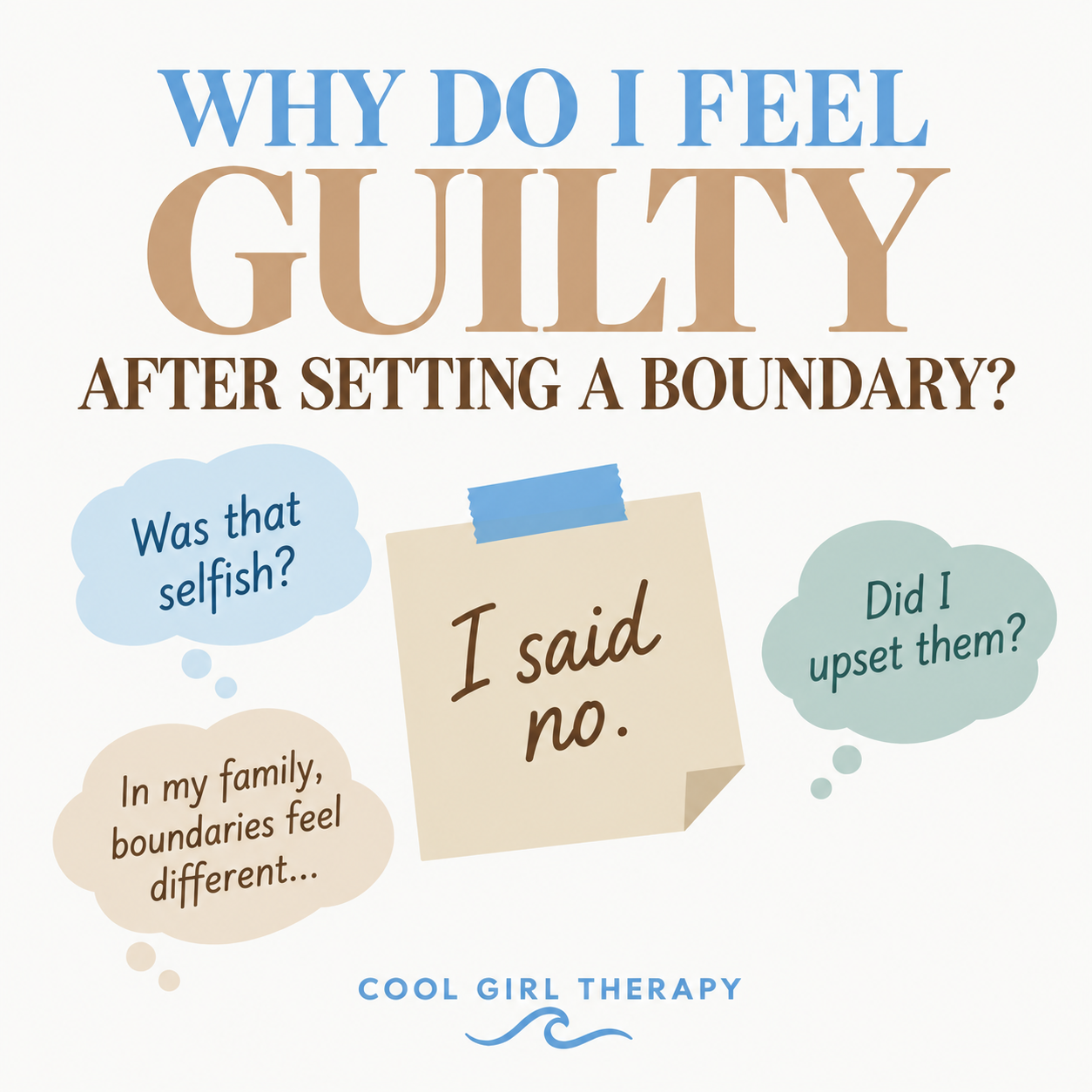
You finally say no.
You don’t overexplain. You don’t make up an excuse. You don’t immediately offer three other ways to make the other person happy.
For about five minutes, you feel pretty good about yourself.
Then the guilt starts.
Was that rude? Maybe I should text them again. They probably think I’m selfish. Honestly, I could probably just do it.
Suddenly, a completely reasonable boundary starts feeling like evidence that you’re a bad person.
If this happens to you, the guilt doesn’t necessarily mean you did something wrong.
Sometimes it means you did something different.
A healthy boundary can still feel awful
People talk about boundaries like they should feel empowering.
Sometimes they do.
Sometimes you say no, put your phone down, and immediately want to crawl out of your skin.
That’s especially common if you’re used to being the flexible one, the understanding one, or the person who says, “It’s fine, whatever works for you.”
If keeping other people comfortable has been part of how you keep relationships feeling safe, saying “I’m not available” can feel much bigger than the actual sentence.
It can feel like:
I disappointed them.
They might be mad at me.
What if they think I’m selfish now?
What if this changes the relationship?
That’s why boundary guilt can feel so intense even when the boundary itself was reasonable.
Guilt doesn’t always mean you’re guilty
Guilt can be useful when you actually hurt someone or behaved in a way that goes against your values.
But sometimes what feels like guilt is really discomfort.
You chose what worked for you instead of automatically choosing what worked for someone else. You allowed another person to be disappointed. You stopped explaining yourself before they were completely satisfied.
Nothing necessarily went wrong.
It just felt unfamiliar.
And unfamiliar can feel surprisingly similar to wrong.
You may have learned that being “good” meant being easy
For a lot of people, this starts young.
Maybe you were praised for being mature, helpful, independent, easygoing, or “no trouble.”
Maybe you learned that things went more smoothly when you didn’t ask for much.
Maybe you could tell when a parent was stressed, tired, disappointed, or in a bad mood, and you learned to adjust accordingly.
Nobody had to explicitly tell you, “Your job is to keep everyone happy.”
You learned the role anyway.
This is part of what I think of as the Cool Child pattern: being the easy child, the responsible one, the one who doesn’t make life harder for anyone else.
Later, that can turn into the Cool Girl pattern in adulthood: being agreeable, understanding, low-maintenance, and very good at making sure everyone else is comfortable.
So when you finally set a boundary, you may not just be saying no to one request.
You may be stepping outside a role you’ve been rewarded for playing your whole life.
That’s part of why the guilt can feel so big.
“Okay, but I’m an adult child of immigrants. Boundaries don’t work the same for me.”
This is where a lot of boundary advice online starts to feel a little unrealistic.
“Just say no.”
“You don’t owe anyone an explanation.”
“Protect your peace.”
And maybe part of you is thinking: Okay, but have you met my family?
If you’re an adult child of immigrants, grew up in a multicultural family, or were raised in a family where interdependence, sacrifice, respect for elders, and family obligation were deeply important, setting boundaries can carry a very different weight.
Saying no to a parent may not feel like a simple interpersonal decision. It may feel tied to gratitude, loyalty, culture, sacrifice, and the fear that choosing yourself means rejecting where you came from.
And sometimes there are real practical ties too. Family may be involved in finances, housing, childcare, career decisions, relationships, or everyday life.
That doesn’t mean boundaries don’t apply to you.
It may mean your boundaries need to look different.
A boundary doesn’t have to mean cutting someone off or adopting a version of independence that doesn’t fit your values. It might mean sharing less information about a decision you’ve already made. Waiting before answering. Deciding which topics you’re willing to discuss. Ending a conversation when it becomes hurtful. Or saying, “I hear that you disagree, but I’m still going to make this decision.”
Sometimes the goal isn’t learning how to care less about your family.
It’s learning how to stay connected to them without disappearing inside the relationship.
Someone being disappointed in you is not the same as you hurting them
This distinction is huge.
Your friend can wish you came to the party.
Your parent can wish you visited more often.
Your partner can be disappointed that you said no.
Their feelings are real.
And you are not automatically responsible for making those feelings disappear.
Healthy relationships have room for two people to have different experiences at the same time.
Sometimes that means:
I understand that you’re disappointed, and my answer is still no.
If you’ve spent years feeling responsible for other people’s emotional states, that can feel incredibly mean.
It isn’t.
It’s learning where your responsibility ends and someone else’s begins.
This is also why you may overexplain
You set a boundary:
“I can’t make it tonight.”
Then you feel compelled to send another paragraph explaining your schedule, your exhaustion, tomorrow’s responsibilities, how much you wanted to come, and why you absolutely would have said yes under different circumstances.
Sometimes explanations are appropriate.
But if every boundary starts feeling like a legal defense, you may be trying to make sure the other person understands you well enough that they won’t be upset.
Unfortunately, you can communicate perfectly and someone may still be disappointed.
That doesn’t mean your boundary was wrong.
The goal isn’t to stop feeling guilty overnight
You may eventually get more comfortable setting boundaries.
But early progress often looks less glamorous:
I feel guilty, and I’m not going to immediately undo the boundary.
You notice the urge to send another text and wait.
You feel uncomfortable without treating the discomfort as proof you made a mistake.
Over time, you start learning something new:
Someone can be disappointed in me.
I can still care about them.
They can still care about me.
And I don’t have to abandon myself to make the discomfort go away.
Therapy for people-pleasing and boundary guilt
For people who have spent years being easy, helpful, agreeable, or emotionally responsible for everyone else, boundaries usually aren’t just about learning the right words.
You probably already know how to say no.
The harder part is what happens afterward: the anxiety, guilt, replaying the conversation, worrying that you were too harsh, or feeling like having needs makes you difficult to love.
That’s often the part we work on in therapy.
The goal isn’t to stop caring about other people.
It’s learning that caring about them and taking care of yourself do not have to be opposites.
If setting a completely reasonable boundary leaves you feeling guilty, anxious, or like you need to immediately take it back, there may be more underneath that reaction than the boundary itself. Schedule a free 15-minute consultation to talk about what’s been coming up and see whether weekly online therapy might be a good fit for you.
Online therapy in California, including virtual therapy for adults in the Bay Area and Los Angeles, focusing on people-pleasing, family expectations, adult children of immigrants, emotional neglect, relationship patterns, and learning how to set boundaries without feeling like you’ve done something terrible.