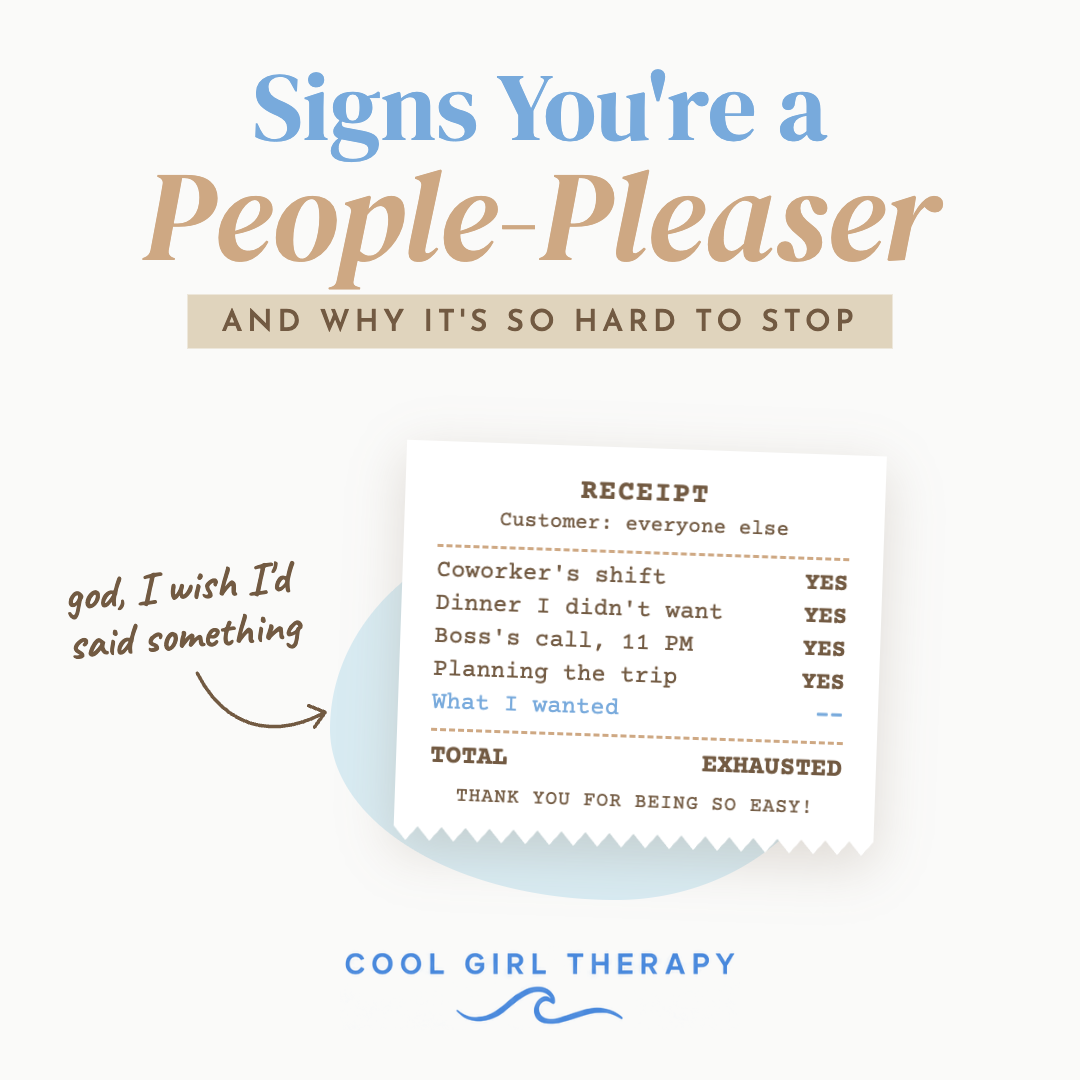
"God, I wish I'd said something, but I kept it to myself."
"I really wanted to go, but I was afraid of disappointing them, so I changed my plans."
"I told my boss I don't take calls after work hours. Then he called at 11 at night, and I picked up. Because I'm a people-pleaser!"
I hear versions of these all the time in my work. Sometimes they come with a laugh, sometimes with real exhaustion. Either way, they usually point to the same pattern.
If you often put other people's comfort ahead of your own needs, and doing anything else feels uncomfortable or even unsafe, you may be a people-pleaser. That isn't a diagnosis, and it isn't a flaw in your character. It's a pattern, and patterns can change.
What people-pleasing actually is
People-pleasing is when you adjust what you say, what you want, and sometimes who you are, so the people around you stay comfortable. Usually it's so you don't have to risk someone being disappointed in you, upset with you, or pulling away.
From the outside, it can look like being kind, easygoing, or low-maintenance. From the inside, my clients often describe it as constant checking. Are they okay? Did I say the wrong thing? What do they need from me?
The kindness is real, and my goal isn't to take it away. It's to help you notice what it has been costing you.
Signs you might be a people-pleaser
You say yes before you've checked in with yourself. By the time you think about whether you have the time or energy, you've already agreed.
You apologize for things that aren't your fault, sometimes just for having a need.
You feel responsible for other people's moods. If someone goes quiet, you assume you did something.
It's hard to name what you want, whether that's where to eat or what you want from your life.
Conflict feels dangerous, not just uncomfortable, so you go along with things to keep the peace.
You feel resentful, then guilty for feeling resentful, and then you say yes again.
Where it starts
Most people-pleasers learned to adapt to survive. Maybe that meant keeping a partner interested, holding onto a friend group, or keeping your role in your family system. I call this the Cool Girl pattern: being easy to be around became the way to stay connected.
A lot of my clients come in thinking that because their basic needs were met growing up, nothing really shaped them. With some time and curiosity, they often find deeper emotional wounds they never had the chance to stop and notice before. Maybe you were the responsible one, the eldest daughter who helped hold everything together. Maybe you grew up between two cultures, where being agreeable kept the peace at home and helped you fit in outside it.
My goal isn't to point fingers at your family or call everything trauma. It's to understand why this pattern made sense, so you can decide whether you still need it.
Why it feels so physical
Many of my clients know, logically, that it's okay to say no. And still, when the moment comes, their heart races, their stomach drops, or a wave of guilt hits before they've finished the sentence.
That's because people-pleasing isn't only a thinking habit. It lives in the body, too. Pushing through it with willpower rarely lasts, and the old pattern comes back the next time the stakes feel high.
What helps is slowly showing your nervous system that disappointing someone is survivable. If saying no leaves you flooded with guilt afterward, I wrote about that in Why Do I Feel Guilty After Setting a Boundary?
What therapy for people-pleasing looks like
I meet you where you're at. We don't try to make you less caring. We make room for you, too. Usually that includes:
Noticing the pattern as it happens, in your relationships and sometimes in our sessions.
Getting curious about where it came from, including family roles and cultural expectations.
Paying attention to your body, so you can catch the moment you're about to override yourself.
Practicing small no's in lower-stakes places, and seeing what actually happens.
Reconnecting with what you want, which can take time if no one has asked you in a while.
Online therapy if you live in the Sacramento area
You don't have to live near me to work with me. As a Licensed Marriage and Family Therapist, I see clients by secure video anywhere in California, including Sacramento, Natomas, Elk Grove, West Sacramento, and Davis.
For a lot of people-pleasers, online therapy is easier to say yes to for themselves. There's no commute and no rearranging your whole afternoon, and you can meet from a place that already feels comfortable.
To learn more about how I work with this, read about people-pleasing therapy in Sacramento and across California. You can also see what happens in the first few therapy sessions or check fees and insurance.
You've spent a long time making sure everyone else is okay. You're allowed to need something too.