What is a “Cool Girl”?
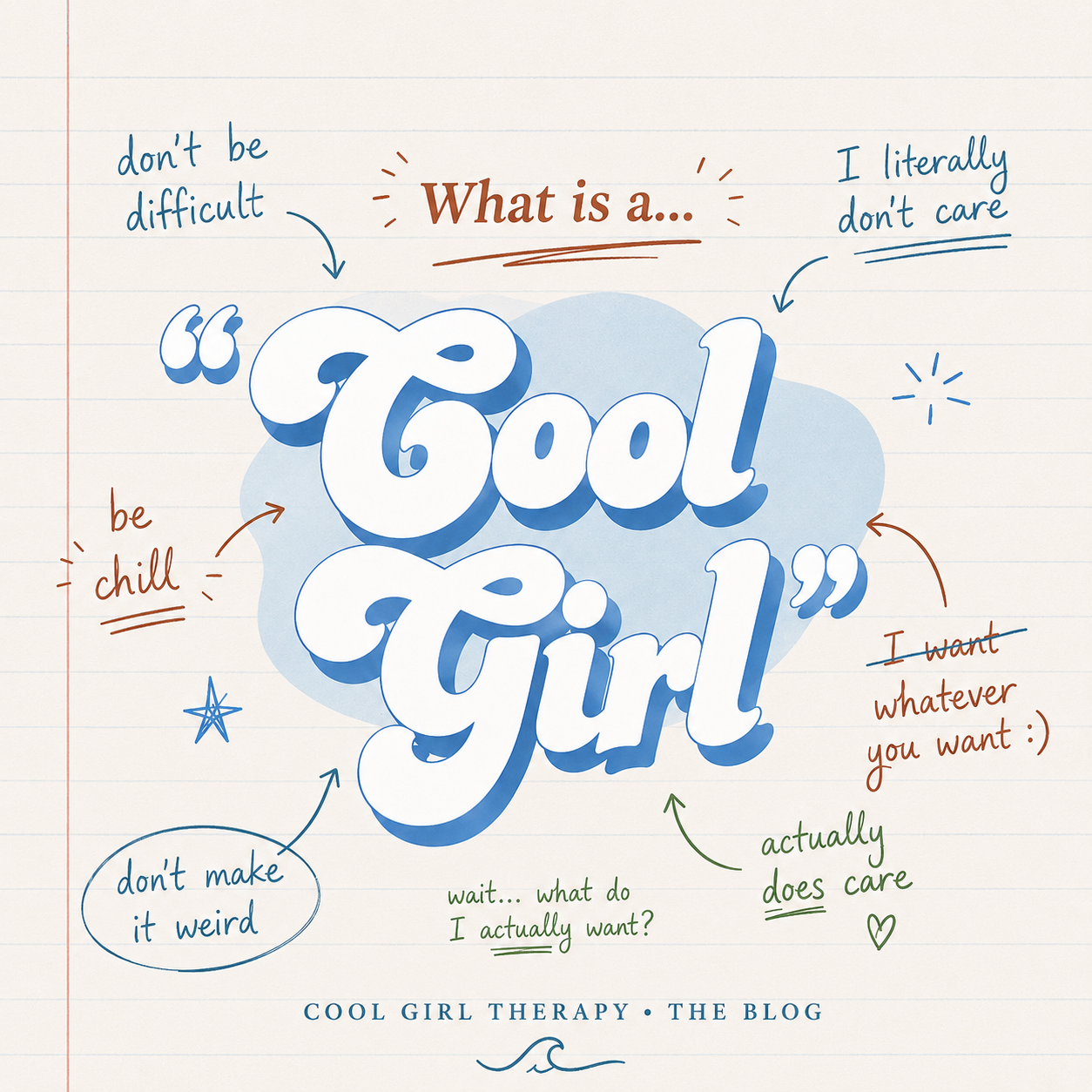
If you’ve heard the name Cool Girl Therapy and thought, Wait, is that from Gone Girl? Yes. But probably not in the way you think.
The term “Cool Girl” became part of the cultural conversation after Gillian Flynn’s 2012 novel Gone Girl. In the book, the Cool Girl is the woman who becomes exactly what a man wants her to be: hot, fun, easygoing, adventurous, never too demanding, and conveniently interested in all the same things he is.
She doesn't get mad when other women might get mad. She doesn't ask for too much. She doesn't make things difficult. She’s just... cool.
The “Cool Girl” became a way of talking about a woman whose desirability depended, at least partly, on how effortlessly she could fit herself around what a man wanted.
But when I started thinking about the Cool Girl as a therapist, I became less interested in the specific woman Flynn was describing and much more interested in the question underneath her:
What happens when we learn that being ourselves might cost us belonging?
The Cool Girl knows who you want her to be
As a therapist, I developed the name Cool Girl Therapy after working with countless clients who came to me with different stories but, underneath them, a surprisingly similar problem: they didn't feel like they could fully be themselves.
They had learned how to mold. To chameleon. To walk into a room and quickly figure out who they needed to be in order to belong there.
With a partner, maybe that means being easygoing and pretending something doesn't bother you because you don't want to be “too much.” With your parents, it might mean choosing the career, partner, lifestyle, or version of success that makes them proud. With friends, maybe you're constantly reading the room and adjusting your personality, your opinions, your clothes, your humor, even what you admit to wanting.
And the thing is, this can work.
You can become really good at fitting in. People like you. Your parents are proud of you. Your partner thinks you're easygoing. Your friends think you're fun. You become the person people want you to be.
But at some point, you may start wondering where everyone else's expectations end and you begin.
Who decided there was a “right” way to be?

There are so many ways a person can exist. Different lifestyles, appearances, cultures, relationships, personalities, values, and ways of building a meaningful life.
Instead, we're constantly being handed instructions for which versions of us are more acceptable. Gender, religion, nationality, race, class, and social media can all give us instructions.
And those instructions can be incredibly specific: what kind of woman is desirable, what kind of man is respected, what a successful adult does for work, what your body should look like, when you should get married, whether you should have children, how emotional you're allowed to be, how much money you should make, and what kind of life you're supposed to want.
There is always some supposedly “right” way to be.
And when you don't naturally fit that version, you have a choice: risk being the odd one out, or start editing yourself.
A lot of us learn to edit.
I know what it feels like to shape yourself around the room
This part of the brand is personal for me. I'm the child of an immigrant mother and grew up with a mixed cultural background. I know what it's like to feel caught between different cultures, expectations, and ideas of who you're supposed to be.
When you grow up feeling like you don't completely fit into one box, you can get really good at molding yourself to the environment you’re in. You notice what's acceptable, which parts of you make sense to the people you're with, which parts require an explanation, and which parts you should turn up or turn down.
I know what it's like to shape yourself based on the room you're in and the people you're talking to.
And that experience is a big part of why I'm so interested in the difference between assimilation and belonging.
Because they're not the same thing.
Assimilation says: I can belong if I become more like you.
Belonging says: I can belong and still be me.
That distinction is at the heart of Cool Girl Therapy.
The problem isn't that we change around other people. We all do that. I behave differently at work than I do with my closest friends. Different people bring out different parts of us. That's normal.
The problem is when you change so much depending on who you're with that you're not really sure which version is you anymore.
When disagreement feels dangerous. When disappointing someone feels unbearable. When you need other people's approval to feel okay about your choices. When being rejected doesn't just mean, this person doesn't like me — it means, there must be something wrong with me.
That's when fitting in can become incredibly lonely.
That's not belonging. That's being accepted for the version of yourself you've learned to show people.
I want there to be room for connection without conformity, belonging without assimilation, and relationships without abandoning yourself.
The Cool Girl isn't always a girl
The original Cool Girl was explicitly gendered. She was a woman performing a particular kind of femininity for male approval.
But the pattern I see in therapy is much bigger than that.
Maybe they're sensitive, want emotional intimacy, or don't actually relate to the way their friends talk about women. But there's pressure to play along. Don't be sensitive. Don't care too much. Don't admit you're hurt. Don't let the guys think you're weak. Laugh at the joke. Go along with the conversation even when it makes you uncomfortable.
Sometimes fitting in with other men means performing a version of yourself you don't even particularly like.
So they chameleon too.
Different version, same basic problem: who do I need to be for these people to accept me?
For children of immigrants, the rules can get even more complicated
I also see this constantly with adult children of immigrants. You're trying to live inside two sets of rules that sometimes directly contradict each other.
Maybe your family comes from a more collectivistic culture where decisions aren't viewed as purely individual. What you do reflects on your family. Your choices affect everyone. Your parents sacrificed for you, and that sacrifice can feel present in every major decision you make.
Then you're growing up in an American culture constantly telling you to follow your dreams, do what makes you happy, set boundaries, and choose yourself.
Okay... so which is it?
For a lot of people, neither answer feels completely right. Choose yourself and you feel selfish. Choose your family and you feel resentful. Set a boundary and you feel guilty. Don't set it and you feel trapped. Date who you want and you're disappointing someone. Date who your family wants and you may be abandoning yourself.
No matter what you do, it can feel like you're fucking up.
And I don't think the answer is deciding that one culture has it right and the other has it wrong. I don't think everyone needs to reject collectivism and become hyper-independent. And I definitely don't think “just set boundaries” solves something this complicated.
I'm much more interested in helping someone slow all of that down enough to ask:
What is actually mine?
What do I believe? What matters to me? What parts of my culture and family do I genuinely value and want to carry with me? What am I doing out of love, and what am I doing because I'm terrified of disappointing someone?
Those aren't always easy questions to answer, especially if you've spent most of your life figuring out what everyone else wants first.
The problem was never wanting to belong
I didn't build Cool Girl Therapy around the idea that everyone needs to stop caring what other people think.
We need other people. We need relationships, community, culture, family, and belonging. We compromise because we love people. We adapt because relationships require us to. None of that is inherently a problem.
The problem is when you aren't really part of the equation anymore.
When being loved means being agreeable. When belonging means becoming more like everyone around you. When keeping a relationship means pretending you're okay with things you're not okay with. When making your family proud means building a life you aren't sure you actually want.
That's what I kept seeing underneath the Cool Girl. The person who becomes whatever a partner wants. The man performing masculinity for other men. The child of immigrants trying to reconcile two cultures. The adult who has built the life everyone told them they should want and can't understand why they still feel empty.
The original Cool Girl gave me language for something much bigger: the ways we learn to edit ourselves in exchange for acceptance.
And that's ultimately where the name Cool Girl Therapy came from.
I don't think the goal of therapy is to stop adapting, stop compromising, or stop caring what anyone thinks. I think it's learning to notice when you've left yourself out of the equation.
What do I want? What do I actually think? What am I okay with? What am I doing because it matters to me and what am I doing because I'm afraid of what will happen if I don't?
Maybe that's the difference I'm trying to get at with this whole brand:
Assimilation asks you to change yourself in order to belong.
Real belonging makes room for who you already are.
You shouldn't have to become the Cool Girl — or anyone else's version of who you're supposed to be to be worthy of connection.
If you want to understand more about how this pattern can show up in relationships, family, identity, and everyday life, read What Is Cool Girl Therapy?.
And if you're tired of trying to figure out which version of yourself everyone else wants, you can schedule a free 15-minute consultation.